Mining
Lithium triangle
Are new discoveries a threat to Latin America's lithium triangle?
across-latin-america, argentina, bolivia, chile, energy, lithium
Lithium is becoming an increasingly strategic resource for developed countries as an essential component of the clean energy transition. South America continues to be the backbone of the global lithium supply chain due to its scale of reserves and its low-cost production capabilities.
Argentina, Bolivia and Chile, together known as the lithium triangle, hold 58% of the world’s identified lithium deposits. In particular, Chile and Argentina are global leaders in lithium production, however each country has its own value chain strategy.
A Chilean academic and lithium expert explained, "Bolivia and Argentina are seeking to advance in the battery supply chain but Chile is taking a more pro-business approach. Bolivia does not want anyone to touch their lithium deposits unless they bring the whole process into Bolivia. Argentina wants to have greater added value but is already working with several transnational companies in exploitation."
"Bolivia and Argentina are seeking to advance in the battery supply chain but Chile is taking a more pro-business approach."
Academic, specialised in lithium production, Chile
"It was commendable to see that the Bolivia government was only going to allow industrialised lithium to be removed from the country," explained a mining executive in Argentina, "but after several years, not a single project has been seen. I think they will end up bidding like Chile and Argentina."
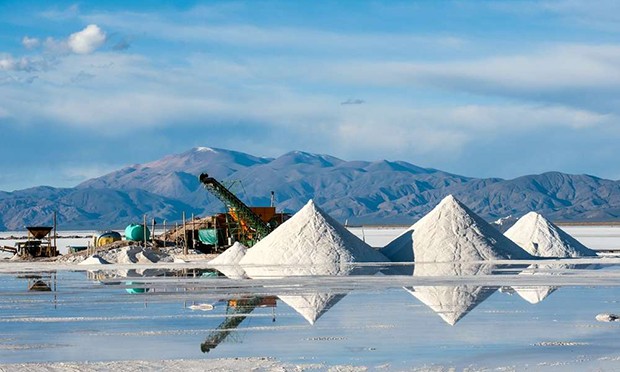
"The importance of lithium in Argentina, Chile and Bolivia is that it has a great comparative advantage: it is made from brine found on the surface of salt flats, so the costs are significantly lower", explained an Argentinian expert and published author on the geopolitics of lithium. The disadvantage is that the lithium is extracted through evaporative processes that are deemed to be environmentally damaging.
Alternatives are starting to emerge. In a recent example, Cornish Lithium, a UK company looking for lithium in hot springs found a large concentration of lithium in geothermal waters in Cornwall which could produce 4,000 tonnes per year of lithium by 2026. The advantage of these reserves, as in others located in Germany and the US, is that the metal can be extracted from geothermal waters, reducing the ecological costs of extractions, with limited carbon emissions.
"I don't believe that the technology exists to extract lithium from geothermal waters economically yet, even if it does, it hasn't been industrialised and this will take years."
Former Vice-Minister of Energy, Bolivia
A former Vice-Minister of Energy in Bolivia wasn't concerned, "I don't believe that the technology exists to extract lithium from geothermal waters economically yet, even if it does, it hasn't been industrialised and this will take years. Also, it will be similar to fracking, higher operating costs will make it unviable without high lithium prices."
The lithium triangle seems safe for the time being but as market demand grows there will be new pressures on cost and on managing the environmental impact. There is still work to do.
Important Notice
While the information in this article has been prepared in good faith, no representation, warranty, assurance or undertaking (express or implied) is or will be made, and no responsibility or liability is or will be accepted by Deheza Limited or by its officers, employees or agents in relation to the adequacy, accuracy, completeness or reasonableness of this article, or of any other information (whether written or oral), notice or document supplied or otherwise made available in connection with this article. All and any such responsibility and liability is expressly disclaimed. This article has been delivered to interested parties for information only. Deheza Limited gives no undertaking to provide the recipient with access to any additional information or to update this article or any additional information, or to correct any inaccuracies in it which may become apparent.